The Conversation
29 Jul 2025, 16:23 GMT+10
Share article
Print article
Forest degradation is increasingly recognized as a major global threat. Such degradation refers to the gradual erosion of a forest's ability to store carbon, support biodiversity and sustain livelihoods, including those of Indigenous Peoples.
International frameworks such as the United Nations Convention on Biological Diversity and the UN Framework Convention on Climate Change now address degradation alongside deforestation.
While tropical forests have long been the focus, attention is also turning to temperate and boreal forests, where forest management is widespread and the potential for degradation is growing.
Some scientists have argued that if forest management is designed to be "ecologically sustainable," then there should be little concern about degradation. But is this principle being upheld in practice? Our recent study in Ontario suggests otherwise.
A widely used strategy to support ecological sustainability is to emulate natural disturbances; that is, to design human-caused disturbances so they fall within the range of variation observed in nature.
The ecological theory behind this approach is that species are adapted to cope with, or even benefit from, natural disturbances. In Canada's managed boreal forests, for example, harvesting is explicitly designed to mimic natural fires, both in individual cutblocks and across the broader landscape.
In fact, this principle is enshrined in Ontario's 1994 Crown Forest Sustainability Act that states:
"The long-term health and vigour of Crown forests should be provided for by using forest practice...that emulates natural disturbances and landscape patterns..."
The ecological sustainability of forest management is not a given: it is a hypothesis, and like any hypothesis, it must be tested. Are we actually managing forests in ecologically sustainable ways, or are we witnessing gradual forest degradation?
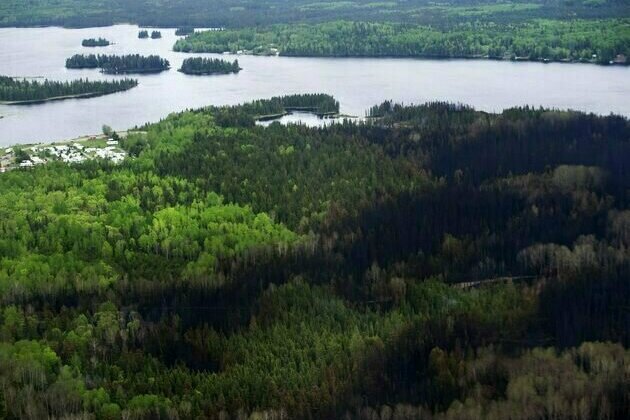
Our study examined the state of a 7.9 million hectare area of boreal forest in northeastern Ontario from 2012 to 2021 to test whether the provincial management regime was emulating natural disturbances, as required by law, or was instead prioritizing timber harvesting.
We used three indicators:
1) The rate at which forest was disturbed (including harvesting and fire).
2) The amount of relatively old forest (greater than 100 years old).
3) Modelled habitat for two species that have been used as indicators of sustainability: America marten and boreal caribou.
Our research did not find evidence that current practices in northeastern Ontario are emulating natural disturbances across the boreal landscape. Rather, the observed disturbance patterns appear to reflect strategies primarily focused on timber harvesting priorities.
A particular risk for boreal forests is a focus on timber production and economic returns over ecological goals. Such an approach is fundamentally at odds with the idea of emulating nature.
In particular, forests older than 100 years old have high ecological value in natural systems. They keep large amounts of carbon out of the atmosphere and provide habitat for myriad species. But if one is prioritizing timber, they are viewed as wasteful because they do not produce timber as rapidly as younger forests and are often targeted for removal. In that perspective, they are labelled "decadent."
We found that the amount of forest disturbed per year was often higher than expected under natural fire regimes and, in some coniferous forest types, even exceeded the rates expected under a strategy that prioritized timber harvesting.
Relatively old forests were also much rarer than in natural landscapes: only 22 per cent of the forest in the study area was more than 100 years old compared to an average of 54 per cent in natural landscapes.
This amount was lower than even the most conservative threshold of natural variability.
Habitats for marten and caribou were similarly degraded and fragmented. Marten habitat covered just 36 per cent of the study landscape, compared to 76 per cent in a reconstructed natural landscape. For boreal caribou, habitat was even more compromised, covering only four per cent of the study area compared to 53 per cent in the natural landscape.
Strikingly, for caribou, levels of habitat disturbance - including disturbances from harvesting, fire and roads - exceeded 70 per cent of the landscape, jeopardizing the sustainability of the two caribou populations.
Surprisingly, the clearest evidence of forest management prioritizing timber occurred within zones meant explicitly to sustain caribou. Our modelling showed that such areas will contain even less caribou habitat in the future than they do today.
The Ontario government is currently revisiting its boreal management strategy - a welcome and timely development. But rather than relying solely on a virtual reality model (Boreal Forest Landscape Disturbance Simulator) to define natural landscapes as is currently the case, it is evident that policy must be grounded in empirical data from real, unmanaged forests.
Scientific research over the past several decades has identified forest management approaches that can deliver timber while also sustaining ecological services within natural bounds.
These strategies, however, rely on tools the province has yet to embrace, including longer harvest rotations, increased use of partial harvesting instead of over-relying on clearcutting, expanded areas set aside from logging, and explicit targets for amounts of forest up to 200 years of age or older.
Our findings indicate that forest degradation is already underway in the boreal forests of Ontario. Substantial changes to forest management are required to reverse this trend and safeguard the ecosystem services on which people and wildlife depend.
Get a daily dose of Toronto Telegraph news through our daily email, its complimentary and keeps you fully up to date with world and business news as well.
Publish news of your business, community or sports group, personnel appointments, major event and more by submitting a news release to Toronto Telegraph.
More InformationNEW YORK CITY, New York: Marc Jacobs, once a crown jewel in LVMH's fashion portfolio, may soon find a new home. The French luxury conglomerate...
SAN FRANCISCO, California: A veteran-led startup that's rethinking how submarines gather intelligence just secured its first round...
NEW YORK, New York - U.S. stock markets made little headway Monday, despite the trade deal negotiated by U.S. President Donald Trump...
SAN FRANCISCO, California: Tesla is rolling out a new ride service in the San Francisco Bay Area, but it won't be the fully autonomous...
U.S. President Donald Trump and EU chief Ursula von der Leyen Sunday announced they had reached a deal to end a transatlantic tariffs standoff...
NEW YORK CITY, New York: A new era in Hollywood is taking shape. U.S. regulators have approved the US$8.4 billion merger of Paramount...
NEW YORK CITY, New York: As cannabis-infused drinks grow in popularity and take over retail shelf space once dominated by beer and...
(250729) -- SINGAPORE, July 29, 2025 (Xinhua) -- Michal Chmielewski of Poland competes during the men's 200m butterfly semifinal of...
Share article Print article Forest degradation is increasingly recognized as a major global threat. Such degradation refers to...
(Photo credit: Daniel Kucin Jr.-Imagn Images) Maybe it's not too late to alter the narrative on the season for the Baltimore Orioles....
New Delhi [India], July 29 (ANI): Geography is an enemy to China's aspirations for a powerful blue-water navy. While one cannot doubt...
Seoul [South Korea], July 29 (ANI): LG Electronics is making a strategic push into the semiconductor equipment sector, focusing on...